Rodney Hide may be gone after the November election but his plan to force other councils to follow the Auckland ‘‘Super City’’ experiment lives on.
If National and ACT get a second term I am worried that a review of local government could see Wairarapa communities such as Masterton, Carterton, Greytown, Featherston and Martinborough, and even coastal settlements like Castlepoint, Riversdale Beach and Ngawi controlled by a large, Wellington-dominated super-city council.
With ex-National leader Don Brash leading ACT any hope of the Wairarapa retaining a strong independent local identity under a KeyBrash regime is probably history. It would be naive to believe that the forced amalgamation of rural and urban councils into the Auckland ‘‘Super-City’’ is a ‘‘unique oneoff’’. It was the first step in a master plan for the whole country.
And we should note that if ACT disappears from the political scene, which is equally likely, then ACT’s amalgamation policies could live on through National as a willing partner to ACT’s amalgamation plans.
Rodney Hide delivered his plan as a minister in the National government. Look at the Government’s record on local government. There was much talk about Aucklanders being allowed to speak with one voice and the ‘‘local’’ being put back into ‘‘local government’’. But local voices were drowned through the consultation process and the local voice was reduced to toothless community boards. Some 75 per cent of property, formerly owned by ratepayers, is now placed under the control of hand-picked, unelected corporate boards. Even now in Auckland we can see the beginnings of the private ownership by the wealthy few of Auckland’s water infrastructure.
The changes in Auckland mean all water and wastewater functions are now managed by Watercare Services Ltd and all transport functions ( except, for the timebeing, motorways) are managed by Auckland Transport. Several other large council-controlled organisations also manage regional facilities, economic development, property development, the waterfront and investments. It is now apparent that amalgamation is accompanied by its hidden agenda – the plan to sell off publicly-owned local government assets.
New Zealand has an appalling experience of privatisation. The sale of New Zealand Rail and Air New Zealand went so pear-shaped that the state had to buy them back. Air New Zealand is again being prepared for sale and, given recent experience, will have to be bought back again at great public expense unless we can stop it.
The sale of Telecom stands out as a failure in terms of developing our telecommunications system. And let us not forget the handing over of our banking system to the Australian banks. The Auckland Super City is a failure that destroys local representation, dilutes democracy and delivers ratepayers’ assets into the hands of the wealthy. Why should the people of the Wairarapa believe this master plan for local government will be any different here?
The disappearance of local bodies must contribute to a loss of identity, especially with youth. It will damage our independence, our sense of identity and opportunities for us to stand up, make a difference, and be proud of it. The more disempowered people feel, the more neighbourliness dies and street crime increases.
In reality the voice of the Wairarapa would be lost in any super city. I’m committed to fighting hard to retain Wairarapa’s independence and voice and standing up against the Government’s proposal to make our wonderful region part of a super city that will destroy our uniqueness, not to mention Wairarapa’s voice.
Tuesday, 3 May 2011


Monday, 2 May 2011
National's Link Of Tough on Crime Policies With Drop In Reported Crime Shown To Be False
Tauranga MP Simon Bridges is appreciative of police work in the Bay of Plenty that has seen the region’s crime rate drop 2.2 per cent per head of population in 2010. “National is committed to taking action on violent crime and making our local communities safer,” says Simon.... “We’ve introduced tough new legislation and given police new tools to deal with crime. “It’s great to see National’s commitment and the hard work of our police making such a positive difference in the Bay of Plenty. ....
“I’d like to commend district commander Superintendent Glenn Dunbier and his staff for their dedication and hard work in keeping our community safe,” says Simon. ... “While we’re pleased to see a drop in recorded crime, our crime rate is still too high.
“National will continue to work with police to bring criminals to justice, address the drivers of crime, and send a clear signal that crime won’t be tolerated.”Posted at 8:38am Saturday 02nd Apr, 2011 "SunLive"
This is an example of National spin where they claim that their "tough on law and order campaign", has led to a lowering of the reported crimes stats. Police Minister Judith "Crusher" Collins advanced the same logic in her piece towards the end of the May edition of "Corrections" the monthly magazine published by the Department of the same name. I am sorry but this is just absolute rubbish.

What has been happening is that since around September 2010 there has been a change in charging policy directed to be followed by all Police Districts across New Zealand from Police National HQ. Also alongside this there has been a greater use of representative charges (i.e one charge representing a "batch" of similar offending). So the use of "alternative resolution" to charging for minor offences has accounted for a reduction in crime stats. The use of discretion is a good thing, but it should not be seen as a result of NACT crime policy. Interesting while reported crime may be down the prison population is up.
Under the pre-charge warning process offenders are still held to account for their actions through arrest, processing at a police station and police recording their warning for future reference.
When an arrest is made a senior officer will consider whether there is sufficient evidence to sustain a charge in court and whether it is in the public interest to take the charge through the court process.
When it is deemed not to be in the public interest to put the person through the court system they will be formally warned.
The process is available for minor offending only and more than 75 percent of offending will be victimless crime.
According to Police policy documents a pre-charge warning can only be considered when the following criteria are met:
The offender must be 17 years or over.
The offence must carry 6 months imprisonment or less.
Victim considerations must be taken into account but the issuing of a formal warning is not contingent on the victim being agreeable.
Reparation considerations must be taken into account but the issuing of a formal warning is not contingent on reparation being made.
Criminal history or previous formal warnings must be taken into consideration but do not exclude a prisoner from receiving a second or subsequent formal warning.
Family violence offending is excluded.
Possession of methamphetamine offence is excluded.
So the reality is very different from the spin. Reported crime is down because fewer people are being charged because Police are quite properly doing something they have had the power to do for decades yet have often failed to do in the past - exercise their prosecutorial discretion. Also there has been a greater use of representative charges. This is a good thing, but it is patently dishonest to claim that a harsher sentencing regime is leading to the drop in the crime statistics.

“I’d like to commend district commander Superintendent Glenn Dunbier and his staff for their dedication and hard work in keeping our community safe,” says Simon. ... “While we’re pleased to see a drop in recorded crime, our crime rate is still too high.
“National will continue to work with police to bring criminals to justice, address the drivers of crime, and send a clear signal that crime won’t be tolerated.”Posted at 8:38am Saturday 02nd Apr, 2011 "SunLive"
This is an example of National spin where they claim that their "tough on law and order campaign", has led to a lowering of the reported crimes stats. Police Minister Judith "Crusher" Collins advanced the same logic in her piece towards the end of the May edition of "Corrections" the monthly magazine published by the Department of the same name. I am sorry but this is just absolute rubbish.

What has been happening is that since around September 2010 there has been a change in charging policy directed to be followed by all Police Districts across New Zealand from Police National HQ. Also alongside this there has been a greater use of representative charges (i.e one charge representing a "batch" of similar offending). So the use of "alternative resolution" to charging for minor offences has accounted for a reduction in crime stats. The use of discretion is a good thing, but it should not be seen as a result of NACT crime policy. Interesting while reported crime may be down the prison population is up.
Under the pre-charge warning process offenders are still held to account for their actions through arrest, processing at a police station and police recording their warning for future reference.
When an arrest is made a senior officer will consider whether there is sufficient evidence to sustain a charge in court and whether it is in the public interest to take the charge through the court process.
When it is deemed not to be in the public interest to put the person through the court system they will be formally warned.
The process is available for minor offending only and more than 75 percent of offending will be victimless crime.
According to Police policy documents a pre-charge warning can only be considered when the following criteria are met:
The offender must be 17 years or over.
The offence must carry 6 months imprisonment or less.
Victim considerations must be taken into account but the issuing of a formal warning is not contingent on the victim being agreeable.
Reparation considerations must be taken into account but the issuing of a formal warning is not contingent on reparation being made.
Criminal history or previous formal warnings must be taken into consideration but do not exclude a prisoner from receiving a second or subsequent formal warning.
Family violence offending is excluded.
Possession of methamphetamine offence is excluded.
So the reality is very different from the spin. Reported crime is down because fewer people are being charged because Police are quite properly doing something they have had the power to do for decades yet have often failed to do in the past - exercise their prosecutorial discretion. Also there has been a greater use of representative charges. This is a good thing, but it is patently dishonest to claim that a harsher sentencing regime is leading to the drop in the crime statistics.

Friday, 29 April 2011
Brash & Banks: Batman & Robin or Dumb & Dumber?
So Don Brash and side-kick John Banks are ACT's and New Zealand's economic saviours. Didn't their last foray involve being on the board of failed fund manager Huljich Wealth Management - whose inadequate corporate governance has led to charges being laid? Brash and Banks walked away from that debacle and now seek to head a political party and incredibly Brash now seems to think that New Zealanders will accept him as Finance Minister.

Thursday, 28 April 2011
Amalgamation and Privatisation Siamese Twins of National/ACT Union
Rodney Hide may be gone after the November election but his plan to “do an Auckland” and force local councils to merge into bigger less representative large bureaucracies lives on. If National-ACT get a second term a review of local government could see Wairarapa communities such as Masterton, Carterton, Greytown, Featherston and Martinborough even coastal settlements like Ngawi controlled by a large Wellington dominated super city council.
With ex National leader Don Brash leading ACT any hope of the Wairarapa retaining a strong independent local identity under a Key-Brash regime will be gone completely. The marketing of the forced amalgamation of rural and urban councils into the Auckland “Super-City” as a “unique one-off” can be seen as another lie. In reality it was a guinea pig master plan the government hopes to force on all NZers.
Consider NACT’s record on local government. There was much talk about Aucklanders’ being allowed to speak with one voice and the “local being put back into local government.” This was pure spin. Local voices are drowned to a whisper with the massive centralisation. The local voice is reduced to toothless community boards and some 75% of property, formerly owned by ratepayers, is now placed under the control of hand-picked, unelected corporate boards. Even now in Auckland we can see the beginnings of the private ownership by the wealthy few of Auckland’s water infrastructure.
In Auckland, the function and role of the corporatised Council Controlled Organisations dominated structural reform. The changes in Auckland mean all water and wastewater functions are now managed by Watercare Services Ltd and all transport functions (except for the time being motorways) are managed by Auckland Transport. Several other large Council Controlled Organisations also manage regional facilities, economic development, property development, the waterfront and investments. I suggest that amalgamation is only one part of a Siamese twin spawned as part of this National-ACT union. The other half still to emerge is the selling off of publicly owned assets.
With the government’s fondness for flogging off assets to its corporate mates, it will only be a matter of time before assets currently controlled by our local councils on behalf of ratepayers are also earmarked to be sold off.
NZ has an appalling experience of privatisation. The sale of NZ Rail and Air NZ went so pear-shaped that the State had to buy them back. Among others Telecom stands out as a failure in terms or developing our telecommunications system despite monopoly profits, most of which went overseas with little reinvestment. Let us not forget the handing over of our banking system to the Australian banks through the sale of the Trustee Savings Banks, the BNZ and Postbank, only marginally remedied to date by the creation of Kiwibank. Most shameful was the bargain basement sale of the Government Printing Office, which jump-started the empire of NZ’s wealthiest man, Graeme Hart.
Since privatisation social goods are minimised and tax-payers witness huge price increases in their power and phone bills. Alongside this there is a marked inadequate investment. NZers still have yet to experience a reasonably priced and secure power supply.
When Telecom was sold, the government lost most of its ability to ensure that New Zealand's telecommunications infrastructure was provided, maintained and developed in the public interest. Again most profits went offshore and there was practically no investment in core infrastructure.
The government has said that they may consider Public Private Partnerships (“PPPs”). If we apply this to a hospital for example the PPP contractor gains powers to decide on aspects of the design of the hospital, who uses its facilities and how they are charged for, and the use of the hospital for commercial activities such as vending machines or franchises such as burger or fried chicken chains. Late last year the government was enamoured with idea of granting a monopoly position in the provision of services and facilities for 25-35 years to corporates in terms of water and sewerage services. This is a seismic shift in power where social utility will take a back-seat to profits for off shore corporations.
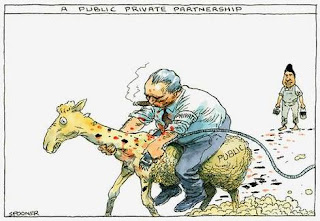
In reality the Auckland Super-City is a failure that destroys local representation, dilutes democracy and just delivers rate-payers assets into the hands of the wealthy. Why should the people of the Wairarapa believe this master plan for local government will be any different here?
I believe the mantra "bigger is better" borrowed from big business but spliced into local government, will mutate into something that is un-New Zealand in terms of democracy.
Simply put the bigger a local authority is, the less say ratepayers have in what happens to the place where they live. More important than the economic failure of this model is the scant regard to the social consequences of this forced amalgamation.
To what extent will the disappearance of our local bodies contribute to a loss of identity, especially with our youth, that sense of identity and the fact that local people feel they can’t stand up and make a difference? In reality, the more disempowered people feel the more neighbourliness dies and the more street crime increases.
A few weeks ago I was in a meeting where Wellington City Mayor Celia Wade-Brown was speaking. The issue of amalgamation was raised. Her view was that Wellington City would be the hub of any Wellington Region Super-City of which the Wairarapa would comprise a part. In reality the voice of the Wairarapa would be lost in any Super-City. Lambton Quay and Porirua have nothing in common with the streets and roads of the Wairarapa. Further assets that have been bought and paid for by ratepayers will be sold off, prices will rise and the profits will go out of the Wairarapa to corporate entities with no social conscience.
I’m committed to fighting hard to retain Wairarapa’s independence and voice and standing up against the Government’s proposal to make our wonderful region a part of a super city that will destroy our uniqueness, not to mention Wairarapa’s voice.
-------------------------------------------------------------------------------------------
"There is no privatisation agenda for Meridian, nor is there for any other SOE." - John Key, July 2009
"... we've asked for advice on extending the mixed-ownership model to four state-owned enterprises, where the Government on behalf of taxpayers would keep a majority stake but offer a minority shareholding to Kiwi investors." John Key, 28 January 2011
With ex National leader Don Brash leading ACT any hope of the Wairarapa retaining a strong independent local identity under a Key-Brash regime will be gone completely. The marketing of the forced amalgamation of rural and urban councils into the Auckland “Super-City” as a “unique one-off” can be seen as another lie. In reality it was a guinea pig master plan the government hopes to force on all NZers.
Consider NACT’s record on local government. There was much talk about Aucklanders’ being allowed to speak with one voice and the “local being put back into local government.” This was pure spin. Local voices are drowned to a whisper with the massive centralisation. The local voice is reduced to toothless community boards and some 75% of property, formerly owned by ratepayers, is now placed under the control of hand-picked, unelected corporate boards. Even now in Auckland we can see the beginnings of the private ownership by the wealthy few of Auckland’s water infrastructure.
In Auckland, the function and role of the corporatised Council Controlled Organisations dominated structural reform. The changes in Auckland mean all water and wastewater functions are now managed by Watercare Services Ltd and all transport functions (except for the time being motorways) are managed by Auckland Transport. Several other large Council Controlled Organisations also manage regional facilities, economic development, property development, the waterfront and investments. I suggest that amalgamation is only one part of a Siamese twin spawned as part of this National-ACT union. The other half still to emerge is the selling off of publicly owned assets.
With the government’s fondness for flogging off assets to its corporate mates, it will only be a matter of time before assets currently controlled by our local councils on behalf of ratepayers are also earmarked to be sold off.
NZ has an appalling experience of privatisation. The sale of NZ Rail and Air NZ went so pear-shaped that the State had to buy them back. Among others Telecom stands out as a failure in terms or developing our telecommunications system despite monopoly profits, most of which went overseas with little reinvestment. Let us not forget the handing over of our banking system to the Australian banks through the sale of the Trustee Savings Banks, the BNZ and Postbank, only marginally remedied to date by the creation of Kiwibank. Most shameful was the bargain basement sale of the Government Printing Office, which jump-started the empire of NZ’s wealthiest man, Graeme Hart.
Since privatisation social goods are minimised and tax-payers witness huge price increases in their power and phone bills. Alongside this there is a marked inadequate investment. NZers still have yet to experience a reasonably priced and secure power supply.
When Telecom was sold, the government lost most of its ability to ensure that New Zealand's telecommunications infrastructure was provided, maintained and developed in the public interest. Again most profits went offshore and there was practically no investment in core infrastructure.
The government has said that they may consider Public Private Partnerships (“PPPs”). If we apply this to a hospital for example the PPP contractor gains powers to decide on aspects of the design of the hospital, who uses its facilities and how they are charged for, and the use of the hospital for commercial activities such as vending machines or franchises such as burger or fried chicken chains. Late last year the government was enamoured with idea of granting a monopoly position in the provision of services and facilities for 25-35 years to corporates in terms of water and sewerage services. This is a seismic shift in power where social utility will take a back-seat to profits for off shore corporations.

In reality the Auckland Super-City is a failure that destroys local representation, dilutes democracy and just delivers rate-payers assets into the hands of the wealthy. Why should the people of the Wairarapa believe this master plan for local government will be any different here?
I believe the mantra "bigger is better" borrowed from big business but spliced into local government, will mutate into something that is un-New Zealand in terms of democracy.
Simply put the bigger a local authority is, the less say ratepayers have in what happens to the place where they live. More important than the economic failure of this model is the scant regard to the social consequences of this forced amalgamation.
To what extent will the disappearance of our local bodies contribute to a loss of identity, especially with our youth, that sense of identity and the fact that local people feel they can’t stand up and make a difference? In reality, the more disempowered people feel the more neighbourliness dies and the more street crime increases.
A few weeks ago I was in a meeting where Wellington City Mayor Celia Wade-Brown was speaking. The issue of amalgamation was raised. Her view was that Wellington City would be the hub of any Wellington Region Super-City of which the Wairarapa would comprise a part. In reality the voice of the Wairarapa would be lost in any Super-City. Lambton Quay and Porirua have nothing in common with the streets and roads of the Wairarapa. Further assets that have been bought and paid for by ratepayers will be sold off, prices will rise and the profits will go out of the Wairarapa to corporate entities with no social conscience.
I’m committed to fighting hard to retain Wairarapa’s independence and voice and standing up against the Government’s proposal to make our wonderful region a part of a super city that will destroy our uniqueness, not to mention Wairarapa’s voice.
-------------------------------------------------------------------------------------------
"There is no privatisation agenda for Meridian, nor is there for any other SOE." - John Key, July 2009
"... we've asked for advice on extending the mixed-ownership model to four state-owned enterprises, where the Government on behalf of taxpayers would keep a majority stake but offer a minority shareholding to Kiwi investors." John Key, 28 January 2011
Wednesday, 27 April 2011
GOVERNMENT FIDDLES WHILE FIRE-SERVICE BURNS
The Christchurch Earthquake has hit the Fire Service. New Zealand fire fighters received huge praise for their heroic efforts in rescuing the people of Christchurch however the cost of doing this could affect the upgrade of aging equipment throughout New Zealand. I understand that the Fire Service has incurred $8.5 million dollars in costs as a result of services in Christchurch. Apparently the Fire Service chief executive Mike Hall expects to absorb the costs by cutting back spending on new fire engines and stations. The Fire Service's earthquake costs again raise long-debated issues about how it was funded through a fire levy on insurance. For home-owners, a portion of their house insurance goes to the fire service levy. Most schools, hospitals and state agencies do not pay the levy. Thanks to this funding stupidity New Zealand is going to be left with a less effective Fire Service. While 15 percent of homeowners are not insured the biggest bludger in terms of avoiding the levy is the Government. Rural New Zealand wants an assurance that if their is a funding shortfall, that this will not be a the loss of service delivery and compromise to the safety of New Zealanders. It is ironic that the Government is busy slashing public welfare and social services yet can find billions of dollars for corporate welfare such as South Canterbury Finance, a plastic waka and millions of dollars for their new fleet of chauffeur driven BMWs with heated seats.
Wednesday, 20 April 2011
Government Attacks Legal Aid For Citizens But Pays Over A Million To Defend Itself
"The Ministry of Health has spent more than $1 million fighting court action by families who want to be paid for looking after severely disabled relatives.
New figures show the Ministry has spent $1.2 million so far fighting seven families who the High Court has ruled are being discriminated against because they care for relatives.
The Ministry is preparing to appeal against that ruling.
Peter Humphreys, whose 23-year-old daughter has a neuro-genetic disorder, says it is unbelievable that even more taxpayers' money will be used in a Supreme Court hearing.
Health Minister Tony Ryall says the case has significant potential implications beyond the health and disability sector, which would cost far more than the legal bill." (Radio New Zealand News 21 April 2011)
This is disgusting. I know of a father who when he turned 65 finally got a pay rise - it was his pension. For the bulk of his adult life he has looked after his two intellectually disabled kids at home. The only difference from other pensioners is that this man cannot retire. When I was at the Masterton A&P show in February I met a couple in their early 30s. They had three autistic children. They were at the start of this lifetime of underpaid service. This couple are on a benefit. Earlier this year John Key said that being on a benefit "was a lifestyle choice". This was no lifestyle choice. This couple are just normal parents who love their kids and want to look after them. It is outrageous that Government after Government have allowed people with disabilities and those parents who look after their disabled children to be consigned to a lifetime of poverty and effective slavery.
This Government has embarked on a hard on law and order crusade. State cash is poured into building new and larger prisons, our right to elect trial by jury is being eroded and thanks to Simon Power you can shortly be tried in your absence. Worse as an accused person you can be penalised for not telling the State what your defence is. Criminal legal aid is attacked, and lawyers who defend accused persons are attacked as being "greedy and bloated". Yet when the Government wants to avoid doing the morally right thing it is okay for them to spend up big with their own legal aid.
We are developing a baked bean conveyer belt justice system where accused people unless they earn less than the minimum wage will not qualify for legal aid. But even if you do, you will not be able to choose your own lawyer. Then we have the new state bureaucracy Public Defence Service ("PDS") - set up to "compete against the independent defence bar." New figures out show the PDS enters guilty pleas at the earliest opportunity at a far greater rate than clients who choose their own lawyers. It was no wonder that most accused persons didn't want to choose to use the PDS.
So the answer to this was for the Government to force you to use them by removing your right to choose your lawyer. The hypocritical thing about legal aid is that it is a loan. When you are granted legal aid unless you are destitute, a caveat is placed against your house. If you needed a loan to build that house you chose your builder - the bank didn't assign you one from the Public Builders Service. Yet now because you need a loan to defend something far more important - your liberty you can't choose your lawyer.
It is disgusting how the Government is eroding our rights and freedoms and is compelling kiwis to use the state PDS which has a track record of pleading guilty to the state's charges sooner than independent lawyers. It is even more disgusting seeing this Government attacking legal aid for citizens yet being happy to spend over $1 million dollars defending themselves from doing what most kiwis believe is morally right.
New figures show the Ministry has spent $1.2 million so far fighting seven families who the High Court has ruled are being discriminated against because they care for relatives.
The Ministry is preparing to appeal against that ruling.
Peter Humphreys, whose 23-year-old daughter has a neuro-genetic disorder, says it is unbelievable that even more taxpayers' money will be used in a Supreme Court hearing.
Health Minister Tony Ryall says the case has significant potential implications beyond the health and disability sector, which would cost far more than the legal bill." (Radio New Zealand News 21 April 2011)
This is disgusting. I know of a father who when he turned 65 finally got a pay rise - it was his pension. For the bulk of his adult life he has looked after his two intellectually disabled kids at home. The only difference from other pensioners is that this man cannot retire. When I was at the Masterton A&P show in February I met a couple in their early 30s. They had three autistic children. They were at the start of this lifetime of underpaid service. This couple are on a benefit. Earlier this year John Key said that being on a benefit "was a lifestyle choice". This was no lifestyle choice. This couple are just normal parents who love their kids and want to look after them. It is outrageous that Government after Government have allowed people with disabilities and those parents who look after their disabled children to be consigned to a lifetime of poverty and effective slavery.
This Government has embarked on a hard on law and order crusade. State cash is poured into building new and larger prisons, our right to elect trial by jury is being eroded and thanks to Simon Power you can shortly be tried in your absence. Worse as an accused person you can be penalised for not telling the State what your defence is. Criminal legal aid is attacked, and lawyers who defend accused persons are attacked as being "greedy and bloated". Yet when the Government wants to avoid doing the morally right thing it is okay for them to spend up big with their own legal aid.
We are developing a baked bean conveyer belt justice system where accused people unless they earn less than the minimum wage will not qualify for legal aid. But even if you do, you will not be able to choose your own lawyer. Then we have the new state bureaucracy Public Defence Service ("PDS") - set up to "compete against the independent defence bar." New figures out show the PDS enters guilty pleas at the earliest opportunity at a far greater rate than clients who choose their own lawyers. It was no wonder that most accused persons didn't want to choose to use the PDS.
So the answer to this was for the Government to force you to use them by removing your right to choose your lawyer. The hypocritical thing about legal aid is that it is a loan. When you are granted legal aid unless you are destitute, a caveat is placed against your house. If you needed a loan to build that house you chose your builder - the bank didn't assign you one from the Public Builders Service. Yet now because you need a loan to defend something far more important - your liberty you can't choose your lawyer.
It is disgusting how the Government is eroding our rights and freedoms and is compelling kiwis to use the state PDS which has a track record of pleading guilty to the state's charges sooner than independent lawyers. It is even more disgusting seeing this Government attacking legal aid for citizens yet being happy to spend over $1 million dollars defending themselves from doing what most kiwis believe is morally right.
Sunday, 17 April 2011
SOME ARE MORE EQUAL THAN OTHERS
I have just spent the weekend with a team of Labour volunteers listening to the concerns of the people of Masterton. A repeated remark was, “no matter how hard I try, I just can’t get ahead”. One hardworking mum from Columbo Street has not bought a block of cheese for her children for months and a leg of lamb is a long remembered luxury. A couple of pensioners told me how they get two hours home help a week and are struggling to get by. These people are not alone. For the majority of people it seems again and again that those at the top of our economy are creaming it while the rest of us are taking the biggest hits.
Hearing these people I remembered back to May last year when the Government with much fanfare announced a tax reform package to “stimulate the economy and take us out of recession.” The goal was to reduce the budget deficit and transform New Zealand into a savings focused powerhouse.
The theory was that by cutting the top income tax rate from 39 per cent to 33 per cent middle income earners would pull themselves up by their boot straps and achieve higher incomes as they would keep more of what they made. And those at the top of our economy could afford to save their extra income, thus kick-starting our economy with the hoped for increase in our New Zealand savings rate.
These cuts were to be balanced by an increase in GST (effectively making the tax cuts self-funding). This increase was supposed to discourage consumption and encourage saving. Company tax was to be cut. This was all meant to act as a draw card for companies to invest and employ more workers. Labour warned at the time that these tax cuts were not affordable and any increase in GST would hit middle and lower kiwis and chew up any tax cuts. The ability to save for most kiwis would remain a fantasy.
Eleven months on, Labour’s warnings have been proven, unfortunately right. On top of rising food and petrol prices, the shock of GST has meant that average kiwis have even less money in their pockets, and any tax cut is spent on just getting by. Pensioners and lower income kiwis have been hit hardest. Business after business are either closing down or cutting staff.
The tax cuts for those on higher salaries has not been saved and invested in job-creation. Instead, it is being geared up with yet more foreign-supplied debt. The latest March figures released by Barfoot and Thompson for property sales in Auckland show those on higher salaries are grabbing expensive properties again with sales of properties worth more than $800,000 rising by 40 percent from March last year. Lower priced houses barely rose in price.
Meanwhile the Government is pushing ahead with its plans for asset sales. Hocking off our assets to foreign buyers and slashing spending is a return to the failed right wing policies of the past. Middle and lower New Zealand are being ignored by this Government and they will be the ones to suffer even more if our nation’s assets are sold off. We are facing cuts to health and education and now if this Government gets a second term we’ll be paying even more to heat our homes and drink water as power companies and public utilities are sold off to wealthy foreign investors. Selling state assets to foreign corporations, will drive up the current account deficit, send profits overseas and drive up costs for Kiwis.
In 2008 this Government campaigned on closing the wage gap with Australia. Now the gap has widened to 30 percent and Bill English is in the embarrassing position of trying to say that this is a good thing as we can make goods cheaper here than in Australia. It appears that Bill English wants us to become the Mexico of the South Pacific.
The Government constantly tells us that the cupboard is bare and we must all tighten out belts. Yet they can:
- Borrow $120 million monthly to fund tax cuts two thirds of which go to the top 10 percent of the population;
- Provide Mediaworks (a company previously owned by the Minister of Broadcasting) with $43 million loan at a rate they couldn't obtain on the open market;
- Find $1.2 billion dollars to bail out private speculators in SCF;
- Find $2 million dollars to build and gift a plastic boat to the Government’s political friends;
- Find $6.8 million to buy themselves a fleet of BMWs to be chauffeured around in.
These things sit awkwardly with not only me but also with the hardworking families and pensioners of the Wairarapa. At a time when ordinary people are struggling to pay grocery bills and weighing up whether to have a warm home or give their children a healthy meal, life under National is very comfortable for those at the top.
Hearing these people I remembered back to May last year when the Government with much fanfare announced a tax reform package to “stimulate the economy and take us out of recession.” The goal was to reduce the budget deficit and transform New Zealand into a savings focused powerhouse.
The theory was that by cutting the top income tax rate from 39 per cent to 33 per cent middle income earners would pull themselves up by their boot straps and achieve higher incomes as they would keep more of what they made. And those at the top of our economy could afford to save their extra income, thus kick-starting our economy with the hoped for increase in our New Zealand savings rate.
These cuts were to be balanced by an increase in GST (effectively making the tax cuts self-funding). This increase was supposed to discourage consumption and encourage saving. Company tax was to be cut. This was all meant to act as a draw card for companies to invest and employ more workers. Labour warned at the time that these tax cuts were not affordable and any increase in GST would hit middle and lower kiwis and chew up any tax cuts. The ability to save for most kiwis would remain a fantasy.
Eleven months on, Labour’s warnings have been proven, unfortunately right. On top of rising food and petrol prices, the shock of GST has meant that average kiwis have even less money in their pockets, and any tax cut is spent on just getting by. Pensioners and lower income kiwis have been hit hardest. Business after business are either closing down or cutting staff.
The tax cuts for those on higher salaries has not been saved and invested in job-creation. Instead, it is being geared up with yet more foreign-supplied debt. The latest March figures released by Barfoot and Thompson for property sales in Auckland show those on higher salaries are grabbing expensive properties again with sales of properties worth more than $800,000 rising by 40 percent from March last year. Lower priced houses barely rose in price.
Meanwhile the Government is pushing ahead with its plans for asset sales. Hocking off our assets to foreign buyers and slashing spending is a return to the failed right wing policies of the past. Middle and lower New Zealand are being ignored by this Government and they will be the ones to suffer even more if our nation’s assets are sold off. We are facing cuts to health and education and now if this Government gets a second term we’ll be paying even more to heat our homes and drink water as power companies and public utilities are sold off to wealthy foreign investors. Selling state assets to foreign corporations, will drive up the current account deficit, send profits overseas and drive up costs for Kiwis.
In 2008 this Government campaigned on closing the wage gap with Australia. Now the gap has widened to 30 percent and Bill English is in the embarrassing position of trying to say that this is a good thing as we can make goods cheaper here than in Australia. It appears that Bill English wants us to become the Mexico of the South Pacific.
The Government constantly tells us that the cupboard is bare and we must all tighten out belts. Yet they can:
- Borrow $120 million monthly to fund tax cuts two thirds of which go to the top 10 percent of the population;
- Provide Mediaworks (a company previously owned by the Minister of Broadcasting) with $43 million loan at a rate they couldn't obtain on the open market;
- Find $1.2 billion dollars to bail out private speculators in SCF;
- Find $2 million dollars to build and gift a plastic boat to the Government’s political friends;
- Find $6.8 million to buy themselves a fleet of BMWs to be chauffeured around in.
These things sit awkwardly with not only me but also with the hardworking families and pensioners of the Wairarapa. At a time when ordinary people are struggling to pay grocery bills and weighing up whether to have a warm home or give their children a healthy meal, life under National is very comfortable for those at the top.
Subscribe to:
Posts (Atom)